The short version
- Own your tools, don't rent them. Since April 2026 I've built 36 active projects with Claude Code. Seven of them replaced WordPress and most of our SaaS stack, cutting software spend about 81% in five months.
- Think in API costs, not subscriptions. Wiring AI into platforms you own is cheaper and more flexible than paying per seat for software that doesn't talk to anything else.
- AEO is won by omnipresence and proven by measurement. Run the same ~50 buyer questions through ChatGPT, Claude and Gemini over time and track who gets cited.
- Keep a human in the decision seat. AI drafts, analyzes and organizes. A person approves, decides and owns the outcome.
- Ask "who needs to know?" Tier AI access for the founder, the team and customers, and never let private data, AI and public exposure meet unguarded.
On Friday, October 2, 2026, I closed out San Antonio Startup + Tech Week with the "coveted" post-lunch slot at Launch SA. Michael Espinoza had seen what I'd built under the hood of Peachtree Rose Marketing a month earlier and told me I had to share it. Five advisors told me not to give this talk; three of them were human, and one was my business attorney. I gave it anyway, because I don't believe in gatekeeping. What follows is the recap, with a bit more depth than an hour allowed.
From threat assessment to agency founder
My background isn't software. I spent a long career in federal service: active duty and reserve Army, then nine years with the Air Force Office of Special Investigations Behavioral Threat Assessment Cell, which is more or less Criminal Minds for the Air Force. I left federal service in 2025 to run Peachtree Rose Marketing full time. We're a marketing agency that does web design, search engine optimization and answer engine optimization, but we've niched hard into video podcasting, which brings serious logistics: 4K multi-camera footage, editing, and publishing to many platforms for many clients.
The 2026 shift: ChatGPT, then Gemini, then Claude Code
In 2025, OpenAI told me I was in the top 1% of ChatGPT users. In January 2026 the team moved to Google Workspace and Gemini, because a whole suite of connected products beats a single chat window when you're running team workflows. Then, in April 2026, I started experimenting with Anthropic's Claude Code, and most of what I showed at Launch SA was built there. Five months later, the way we do business internally and for clients has fundamentally changed.
A practical note from the Q&A: I pay for all three consumer subscriptions so I can experiment, but I no longer think in subscriptions. I think in API costs, wiring each model into a platform we own and dialing down the cost of every call.
The seven systems (out of 36)
I picked these seven because most businesses have a direct parallel. Together they replaced WordPress and most of the software we used to rent.
| System | What it does | What it replaced |
|---|---|---|
| PRM Content Engine | AI-written, SEO and AEO-optimized long-form blog articles that follow each brand's voice dossier, with real-time industry feeds | Generic AI content and the three-paragraphs-that-say-the-same-thing problem |
| OSINT Lead | Lead generation that cross-references open-source data to find ideal clients and shape the right pitch | Paid lead-generation SaaS |
| OSINT CRM | Our own customer relationship manager: who we talked to, interest, follow-ups | HubSpot and Zoho-style CRMs |
| ContentSiteEngine | A WordPress-like CMS on our own private servers with automatic backups, magic links and 2FA | WordPress, premium plugins and shared hosting |
| Builtstax | Website analysis, automated AI quoting, a team console, an editor claims board, a knowledge portal and AEO measurement | BuiltWith-style lookups, quoting tools, scattered team docs |
| Editor Cadence | Short-form copy per platform in each show's voice, plus branded burned-in captions | Captioning and scheduling SaaS for short-form |
| Asset Beacon | An hourly inventory of every computer, our NAS and Google Drive, so we know where every file lives and what's backed up | Remoting into machines and hoping |
Under all of it sits physical infrastructure: private servers with automatic backups, a network-attached storage (NAS) system with both local and cloud access, and SkyTech gaming workstations. We bought those for 4K editing, and they now also run Claude Code instances and agentic workflows.
The Content Engine, and finding the real customer
It started in late April with a WordPress plugin that writes search-optimized blog articles without AI fluff, while following each brand's dossier for how it actually speaks to its audience. We tested it across five industries (two businesses we own, podcasting and our agency, plus three clients) and could attribute both Google rankings and AI citations to the content.
Then came the founder lesson. I realized my best customer wasn't the mom-and-pop business; it was the agency that already builds WordPress sites and sells recurring SEO. The first agency owner I pitched was open to the product but not comfortable bringing AI into his team's workflow. That didn't end the idea; it sharpened it. I didn't need one agency, I needed seventy-five, which is exactly why we built a lead generator next.
How we cut SaaS costs by 81%
Our biggest expenses are, in order, personnel, office space (five private offices, two of them podcast studios, with a third studio being built in Boerne) and then software as a service. That third line is the one we attacked. Every time we found ourselves paying a subscription for something we could refine and own, we built it: lead generation became OSINT Lead, which created the need for our own CRM, which led to our own CMS.
The website platform is the clearest example. A robust WordPress site with premium plugins can run around $84 a month; on our own platform, with the same capability and better speed, it's closer to $1 a month at scale. Owning it also means we can fix technical SEO and AEO directly on the server instead of fighting a third party's plugins.
The non-negotiable: if you build your own tools, you own your security too. Ours use magic-link sign-in and two-factor authentication, customer and prospect data is protected, and cyber insurance is a must. Building it yourself doesn't make security optional.
Builtstax: one tool that kept growing
Builtstax started as our internal take on BuiltWith, a way to see what a prospect's website runs on. It became an automated quoting platform that estimates the redesign from what it sees, then a team console where non-developers can run AI workflows in plain language. I'm a self-described vibe coder, not a software engineer, and most of my team are video editors and drag-and-drop web designers; they shouldn't need to know Claude Code to benefit from it.
Two features matter most to the culture:
- The claims board. Editors call dibs on the shows they want. If business and politics energizes one editor and a beauty show suits another, they choose. Whether someone is a contractor or an employee, I want them to have agency and ownership over their work.
- The knowledge portal. Anyone can ask how the business works, what SSH means, or where last Friday's footage landed, and get an answer without waiting on me. I don't want to be the bottleneck.
Answer Engine Optimization: getting cited, and proving it
Search engine optimization is how you get found on Google or Bing. Answer engine optimization is how you get cited as the expert or the recommended business by Claude, ChatGPT and Gemini. Plenty of vendors sell AEO; very few let you measure it. So we built measurement into Builtstax.
How we measure AI citations
- List your known competitors, and ask AI who it considers your competitors in your geography.
- Pick about 50 high-intent questions a buyer would actually ask, such as "What's the best podcast studio in San Antonio?"
- Run the same 50 questions through the same three platforms (Anthropic, OpenAI and Gemini) on a recurring schedule.
- Track which brands appear and how that AI share of voice moves over time. One query is an anecdote; the same query over months is data.
Someone in the room asked the right follow-up: how do you know the results are accurate? Holding the questions and platforms constant is the check. Is there a better way? Almost certainly, and we'll keep refining it. Another attendee mentioned they'd found both me and a fellow San Antonio studio owner in the audience by asking ChatGPT and Claude exactly that question, which is about as live a demo as AEO gets.
Why omnipresence wins
AI models read books, YouTube transcripts, Reddit threads and the web in close to real time. The brands that get cited are the ones mentioned in many places. That's a big reason we lean into video podcasting: one episode produces a transcript, descriptions, long-form video and a stack of short-form posts on Instagram, TikTok and LinkedIn, all text that AI picks up.
Picture a local florist sponsoring a podcast about flowers. Each episode mentions the brand mid-roll and in every text asset: who they are, what they sell, who it's for and where. Multiply that across long-form and short-form, and you've built the kind of footprint answer engines cite. Each platform weighs sources differently: Gemini benefits from Google owning YouTube, the world's second-largest search engine, while ChatGPT is widely seen as favoring human forum content like Reddit. That's why you measure each one separately.
From the Q&A: the platforms differ, and they're biased
The room had fun characterizing the big three: Claude as the professor, Gemini as the know-it-all big brother, ChatGPT as the high school quarterback. My advice was a simple experiment. Ask all three the same opinion question in exactly the same words. Then tell each one what the others said, quoting their answers. Watch how each platform responds to its competitors. Every one of these tools is built to keep you on its platform, and that bias shows. In the end the right one is the one whose output fits you and your audience. It comes down to vibes.
A virtual advisory board, with a human in the chair
The part my attorney warned me about: I built an AI advisory board of five personas (a COO, CFO, CMO, CTO and Chief People Officer), named by a Marvel-loving team. Each has siloed access to one slice of the business through its own API keys. The virtual CFO sees accounting and subscription revenue; the others see their own domains. None of them cross streams. They brief me in the morning and afternoon and answer when I ask.
The silos are the point. When the CMO wants to invest and the CFO says "not without evidence," I want to hear both arguments and make the call myself, rather than have the models concede to each other and harden their own biases. If any seat had veto power, I said, it would be the CTO's, because with AI the person who understands the technical and cybersecurity risk should be able to say, "No, that's dangerous."
An attendee raised a fair limitation: a closed-loop advisor can be backward-looking when a regulation or best practice changes. Agreed. I don't use the board for that; for current best practice I go to a live model. Where freshness matters, as in our content tools, we feed real-time, industry-specific RSS briefs into the workflow.
"Who needs to know?" Tiered AI access
An Army sergeant major I served with hung a sign in our office: "Who needs to know?" Everyone performs better with more information, up to the point where it becomes proprietary or sensitive. I apply the same rule to AI, in three tiers:
- Founder: the advisory board, closed-loop, and only I have access.
- Team: a knowledge base for operational questions, like where a file is or what a term means.
- Customer: the familiar website chat ("Can you ship in two to three days?") with no access to proprietary frameworks.
Behind the tiers is what I called the lethality triangle: private data, plus AI, plus public exposure. When all three meet in one system, bad things can happen. Our rule is to remove at least one side of the triangle wherever we can.
Editor Cadence and Asset Beacon: terabytes of 4K, organized
We handle somewhere between one and four terabytes of footage a week across 15 to 20 recurring clients. Editor Cadence keeps each show on-brand at that scale. Every show has a brand dossier, and every platform has its own dossier that updates with current rules (if TikTok wants five hashtags, it writes five). When a vertical short and its AI-assisted script land in the same Google Drive folder, Editor Cadence pairs them and drafts copy for Instagram, Facebook, TikTok, YouTube Shorts and more. The same editor who watched the full episode stays in the loop to catch what's off-brand or fix a guest's last name. We also just rolled out brand-specific burned-in captions for short-form, which is where a lot of our SaaS savings came from; we still use Descript for full-length episodes.
Asset Beacon polls every computer, our NAS and Google Drive every hour, so we know which machine an SD card was offloaded to, what's backed up, and what's safe to clear for new projects.
Case study: 12 interviews at The Monarch Hotel
The Friday before the talk, a U.K. client hired us to capture 8–10 podcast-style interviews during a conference at The Monarch Hotel. We delivered 12 interviews plus a full one-hour talk in front of a live audience, shot on three camera angles to physical SD cards with plenty of redundancy. Afterward, Claude Code, with access to our repositories and Asset Beacon, worked through the files, sizes and camera angles. It can now read video frames to see how many people are on screen and where, and it organized everything into a clean, labeled package the client's U.K. editing team could start cutting from immediately. The client loved it.
That job produced a runbook. Four days later, on a shoot at the Alamodome with a long-running podcast, two metal bands and a legendary rocker, the same process ran again: a human offloaded the cards, and minutes later the package was organized in Google Drive. Every production makes the next one faster.
What's next: San Antonio Podcasting
I closed with an announcement. San Antonio Podcasting is a brand I've been building over the past year, deliberately studio-agnostic and business-agnostic. It isn't meant to promote Peachtree Rose Marketing or Podcast Studio San Antonio. The goal is to establish it as a nonprofit in 2027 (it isn't one yet) that connects the whole local ecosystem:
- Shows and hosts, whether they record in a studio or a basement
- Guests, including subject-matter experts who'd rather appear on podcasts than host one
- Studios across San Antonio
- Sponsors and local businesses who want to get in front of the right audience
Podcasting is a phenomenal marketing channel and an underused advertising one, and San Antonio hasn't fully stepped up locally yet. That's the gap.
From the Q&A: sponsors, stance and brand alignment
The last question: how do you match sponsors with shows that take strong positions? Content that takes a stance tends to reach the right audience, but it can collide with a sponsor's comfort zone. Have the alignment conversation up front, the way you would with a business partner, so everyone knows the left and right limits of what the show will say. When the host and the sponsor share the same audience and values, that's the sweet spot. It's also why I like working with businesses that sponsor their own podcast: it keeps their voice their own.
Try this tomorrow
- Pick one recurring task or subscription that frustrates you: a report, a follow-up, a spreadsheet.
- Describe it in plain language to an AI coding tool like Claude Code and build the smallest version that works.
- Keep the human in the loop and protect the data from day one. Then measure what it saved you.
Video chapters
- 00:00Introduction by Michael Espinoza at Launch SA
- 01:27From Air Force threat assessment to marketing agency founder
- 04:27The 2026 AI strategy shift: ChatGPT, Gemini, and Claude Code
- 06:00The seven systems that replaced WordPress and SaaS
- 09:24Physical infrastructure: private servers, NAS, and SkyTech workstations
- 11:08Case study: the PRM Content Engine and pitching agencies
- 12:57OSINT Lead: lead generation with open-source intelligence
- 13:49Cutting SaaS costs 81% with a custom CRM
- 15:48ContentSiteEngine: speed, security, and owning your platform
- 19:42Builtstax: automated quoting, vibe coding, claims board, and knowledge portal
- 23:19Answer Engine Optimization: getting cited by ChatGPT, Claude, and Gemini
- 30:19Digital omnipresence and brand citations from podcast transcripts
- 33:57Audience Q&A: how the AI platforms differ, bias, and subscriptions
- 40:23Building an AI advisory board with siloed personas and veto power
- 44:53“Who needs to know?”: tiered AI access and the lethality triangle
- 50:19Editor Cadence and Asset Beacon: managing terabytes of 4K video
- 56:10San Antonio Podcasting announcement
- 57:42Q&A: sponsors, taking a stance, and brand alignment
Frequently asked questions
How did Matt Nelson cut his software costs by 81%?
By replacing subscription software with tools his agency owns. Starting in April 2026, Matt used Claude Code to build a website platform (ContentSiteEngine), a CRM, a lead generation tool, a quoting and team platform (Builtstax), and content and media tools. Owning them means paying for hosting and AI API usage instead of per-seat subscriptions; a robust WordPress site, for example, went from about $84 a month in hosting and premium plugins to roughly $1 a month on the agency's own platform.
What is Answer Engine Optimization (AEO)?
Answer Engine Optimization is the practice of getting a brand cited and recommended by AI assistants such as ChatGPT, Claude and Gemini, the way SEO gets a site ranked on Google and Bing. Matt's view is that AEO is won through omnipresence: consistent brand mentions across video, podcast transcripts, social posts and forums that AI models read.
How do you measure whether AI is citing your business?
Matt's agency runs the same set of about 50 high-intent questions, such as “What's the best podcast studio in San Antonio?”, through the Anthropic, OpenAI and Gemini APIs on a recurring schedule. Because the questions and platforms stay fixed, changes in which brands appear show a real trend in AI share of voice instead of a one-off answer.
What is an AI advisory board?
It is a set of AI personas, in Matt's case a virtual COO, CFO, CMO, CTO and Chief People Officer, each given access to only one slice of the business's data through separate API keys. They brief the founder twice a day and answer questions independently. They never share data or merge answers, so their disagreements stay visible and the founder makes the decision.
What is the lethality triangle in AI security?
As Matt described it, risk spikes when three things meet in one AI system: access to private data, an AI model acting on it, and exposure to the public. His rule is to remove at least one of the three wherever possible, for example by keeping the founder's advisory board closed-loop and giving customer-facing chat no access to proprietary data.
Do you need to be a software engineer to build tools like this?
No. Matt describes himself as a vibe coder, not a software engineer. He builds by describing what he needs in plain language to Claude Code, testing it like a customer would, and refining it, while taking security seriously with magic-link sign-in, two-factor authentication and protected customer data.
What is San Antonio Podcasting?
San Antonio Podcasting is a studio-agnostic community brand Matt has been building to highlight San Antonio's podcast shows, hosts, subject-matter-expert guests, studios and sponsors. The goal is to establish it as a nonprofit in 2027, separate from Peachtree Rose Marketing and Podcast Studio San Antonio.
Special thanks to Michael Espinoza and Launch SA, Geekdom, the City of San Antonio, and everyone who jumped in with questions. Video podcast production by Peachtree Rose Marketing.
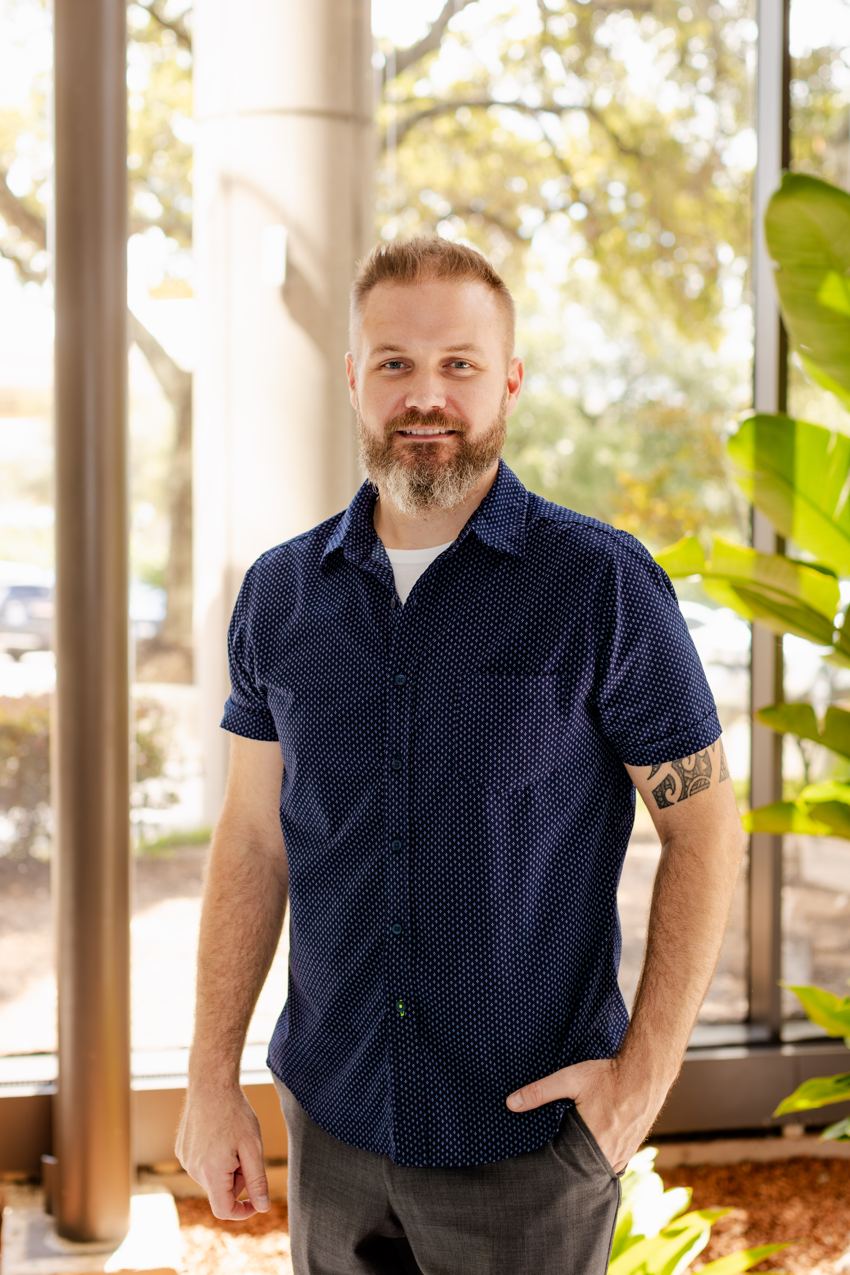
Matt Nelson
Founder of Peachtree Rose Marketing and Podcast Studio San Antonio. Former Army HUMINT interrogator and Air Force OSI behavioral threat assessor. Builds his agency's tools with Claude Code, in public. More talks →